There was a time when eye cream for mature skin was often considered optional in a skincare routine. Many people treated it as a luxury product rather than something essential. However, modern skincare research and product development have changed that perception significantly. Experts now confirm that targeted eye treatments can effectively address many of the unique concerns associated with the delicate skin around the eyes.
According to oculoplastic surgeon and facial aesthetics doctor Dr Maryam Zamani, the skin around the eyes behaves very differently compared to the rest of the face. This area contains fewer oil glands, making it naturally drier and more vulnerable to dehydration. Combined with the constant movement caused by blinking and facial expressions, the orbital area becomes one of the first places where wrinkles and fine lines appear.
As time passes, these effects accumulate. Even if you have never used an eye cream before, incorporating one into your routine can noticeably improve hydration, smoothness, and overall radiance around the eyes.

Top Eye Creams For Mature Skin
| Eye Cream | Primary Benefit | Key Ingredients | Product Size |
|---|---|---|---|
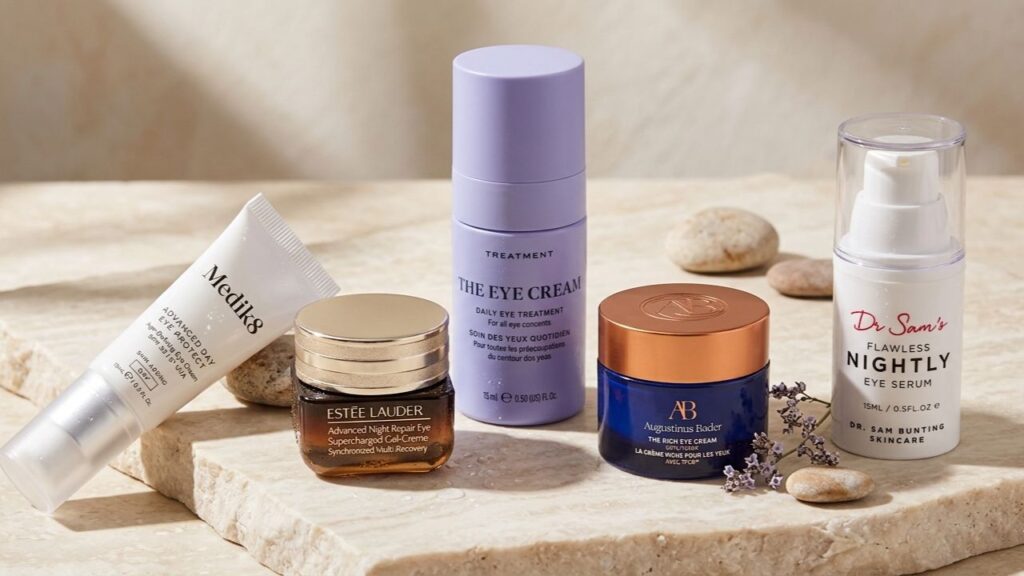
| Dr Sam’s Flawless Brightly Eye Serum | Brightening and dark circle reduction | Niacinamide, milk thistle extract, AGH | 15ml |
| Skin Rocks The Eye Cream | Reducing fine lines | Tripeptide complex, microalgae extract | 15ml |
| MZ Skin Microtox Tightening Eye Serum | Reducing puffiness | Multimolecular hyaluronic acid, tetrapeptides | 15ml |
| Medik8 Advanced Day Eye Protect | SPF protection for daytime use | UV filters, moringa extract, carnosine | 15ml |
| Reome Firming Eye Treatment | Firming and elasticity support | DHK-3 antioxidant complex, ceramides, algae extract | 15ml |
| Estée Lauder Advanced Night Repair Eye Gel-Creme | Lightweight hydration | Tripeptide-32, sodium hyaluronate | 15ml |
| Augustinus Bader The Rich Eye Cream | Deep nourishment for dry skin | TFC8 technology, peptide complex | 15ml |
| Seabody Pentabrite Eye Serum | Suitable for sensitive eyes | Marine complex Maraderm, caffeine, kojic acid | 15ml |
Expert Insights
Two leading experts often referenced when discussing eye care are Dr Maryam Zamani, founder of MZ Skin, and cosmetic dermatologist Dr Sam Bunting. Both specialists emphasize that the skin surrounding the eyes requires specific formulations designed to support hydration, collagen production, and circulation.

Do Anti-Ageing Eye Creams Actually Work?
While eye creams cannot reverse aging entirely, they can significantly improve several visible concerns. According to Dr Zamani, well-formulated eye creams help manage dehydration, fine lines, puffiness, and dark circles linked to circulation or pigmentation issues.
Dr Sam Bunting explains that as people approach menopause, typically around the early fifties, two major changes occur in the skin. First, the skin becomes noticeably drier. Second, collagen production begins to decline at a faster rate. In fact, research suggests that nearly thirty percent of collagen can be lost within the first five years of this transition.
When collagen levels decrease, the skin becomes thinner. This makes the delicate eye area even more prone to wrinkles and creasing. Thinner skin also allows underlying blood vessels and muscles to show through more clearly, which can contribute to darker under-eye shadows and a fatigued appearance.
An effective eye cream for mature skin usually focuses on boosting hydration and encouraging collagen production. By improving skin density and moisture levels, the appearance of underlying structures becomes less noticeable.
Key Ingredients To Look For
Experts agree that hydration and collagen support are the two most important priorities when selecting an eye cream for mature skin.
Important ingredients include:
- Multi-molecular hyaluronic acid to maintain deep hydration
- Ceramides that strengthen the skin barrier and prevent moisture loss
- Peptides and growth factors that stimulate collagen production
Dr Bunting also highlights several active ingredients that provide targeted benefits:
- Retinoids that encourage collagen production and smooth wrinkles
- Vitamin C, bakuchiol, and niacinamide to help rebuild collagen during daytime routines
- Niacinamide to regulate melanin transfer and reduce pigmentation
- Milk thistle extract which shows promise for treating hyperpigmentation
- Alpha glucosyl hesperidin and vitamin K that improve circulation and reduce puffiness
- Nourishing ingredients such as shea butter, avocado oil, and mango seed butter that calm inflammation
- Ectoin which protects the skin barrier and enhances antioxidant protection
Sun protection is also essential. Dermatologists recommend applying sunscreen around the eyes daily, preferably using a mineral formula if sensitivity occurs.
Ingredients To Avoid
Certain ingredients can irritate the sensitive eye area, especially for mature skin. Experts generally recommend avoiding:
- High concentrations of alcohol
- Artificial fragrance
- Strong exfoliating acids
If using retinoids around the eyes, they should be introduced gradually to reduce irritation and allow the skin to build tolerance.
How Eye Creams Are Tested
When evaluating eye creams for mature skin, several performance factors are considered. Texture is important because the product must feel comfortable on delicate skin and absorb easily without heaviness.
Testers also examine how quickly the formula sinks into the skin, whether it layers well under makeup, and how effectively it addresses key concerns such as dehydration, puffiness, and fine lines over time.
What Eye Creams Cannot Do
Despite their benefits, eye creams have limitations. Dr Bunting notes that they cannot permanently lift sagging skin. Elastin fibers, responsible for skin elasticity, are not regenerated after puberty. Therefore protecting existing elastin through sunscreen and antioxidants is crucial.
Eye creams also cannot significantly correct structural eye bags caused by fat pads, muscle changes, or bone structure. In such cases, surgical or medical treatments may be required.
Similarly, deep pigmentation issues or tear trough hollowing may need professional dermatological treatments such as fillers or specialized procedures.
How To Apply Eye Cream Correctly
Eye cream should be used both morning and evening as part of a complete skincare routine. After cleansing the skin and applying a facial serum, gently tap a small amount of eye cream around the orbital bone.
Some premium formulas include cooling applicator tools that help stimulate circulation and reduce puffiness. While these tools are optional, chilling them in the refrigerator can enhance their soothing effect.
Applying the cream with gentle tapping motions rather than rubbing helps protect the fragile skin. Any remaining product can be lightly spread toward the brow bone to extend its benefits.

However, it is generally best to avoid applying eye cream directly on the eyelid unless recommended by a dermatologist, as the skin there is extremely sensitive and prone to irritation.